

AI agents see code, not intent
Cursor and Copilot read your repo. They have no idea what the feature is for, who asked for it, or what was decided in the product spec review.
Product owners drafting specs. Leaders planning capacity-aware roadmaps. Designers connecting Figma. Engineers shipping code. Every AI agent in Codara reads from the same shared product context — so the work fits the product, end to end.
The problem
AI-assisted development is everywhere — and yet the agent is the least informed person on the team. It sees the repo, maybe a few MCP feeds, and a one-paragraph user story. Everything that makes the work matter — the goals, the product spec, the design rationale, the decisions — lives elsewhere.
Cursor and Copilot read your repo. They have no idea what the feature is for, who asked for it, or what was decided in the product spec review.
Product specs in Notion, designs in Figma, decisions in Slack threads, tickets in Jira. The information the AI needs most is spread across systems it has no access to.

You end up the human bridge: copying summaries, design notes, and rationale into prompts so the AI doesn’t go off the rails. Repeat per story, per agent.
How it works
Codara isn't a chatbot stapled to a ticket system. It's a workspace designed so the AI Coding Agent inherits every decision upstream of the story.
A funded bet on a product outcome — what we’re trying to change for users and the business.
Problem framing, success metrics, scope, and acceptance-test plan — drafted by the PM Initiative Agent, edited by a human.
Flow maps, wireframes, and design decisions linked to the product spec so trade-offs are recorded, not lost.
Architecture decisions, data model, API surface, security posture — the technical why behind each epic.
Groomed work item with acceptance criteria, sub-tasks, and links back through the whole chain above.
Reads everything upstream — not just the story. Produces a diff that respects the product intent, not a guess from a prompt.
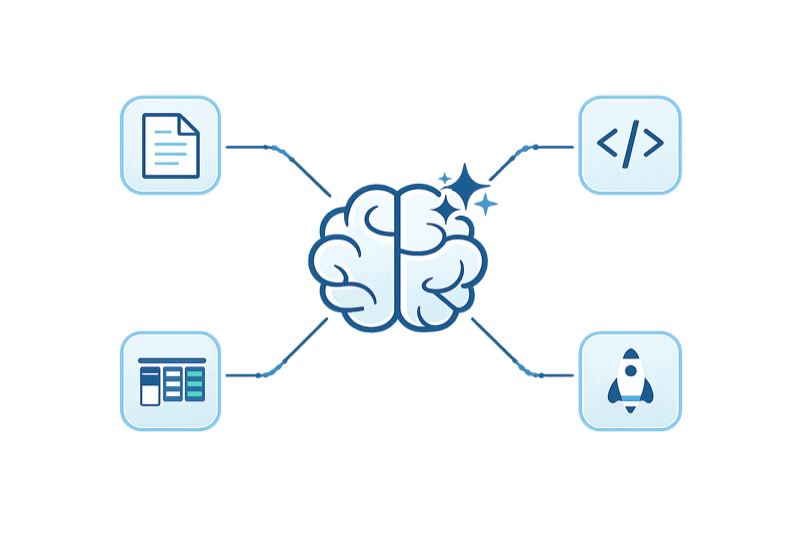
The chain works for every role, not just engineering. Product owners get an Initiative Agent that drafts specs and tests feasibility. Leaders get a Capacity & Planning Agent that builds roadmaps from real estimates. Designers get an agent reading their Figma. And by the time the Coding Agent writes a diff, it already has every upstream artifact in its working memory — no 2,000-token prompt required.
One platform
Project management, collaborative documents, query language, and Git integration built as one product, not stitched together.
Issue types, statuses, transitions, and approval gates that match how your team actually works. No rigid templates.
Real-time collaborative editor backed by Y.js, with version history and deep links between product specs, engineering proposals, and issues.
30+ fields, operators, and functions. Save any view; share it as a link.
Kanban, scrum, capacity, and burndown — natively wired to your issues, code, and docs.
Branches, pull requests, commits, and continuous-integration checks link to issues automatically. Pull-request risk scored in context.
SAML SSO, SCIM provisioning, MFA, IP allowlisting, full audit log, Postgres row-level isolation.
AI agents
Product owners get an Initiative Agent for spec drafting and feasibility. Leaders get a Capacity & Planning Agent that builds roadmaps from real team estimates. Designers get an agent that reads Figma. Engineers get a Coding Agent that inherits all of the above — every artifact upstream is in its working memory, with humans approving at each handoff.
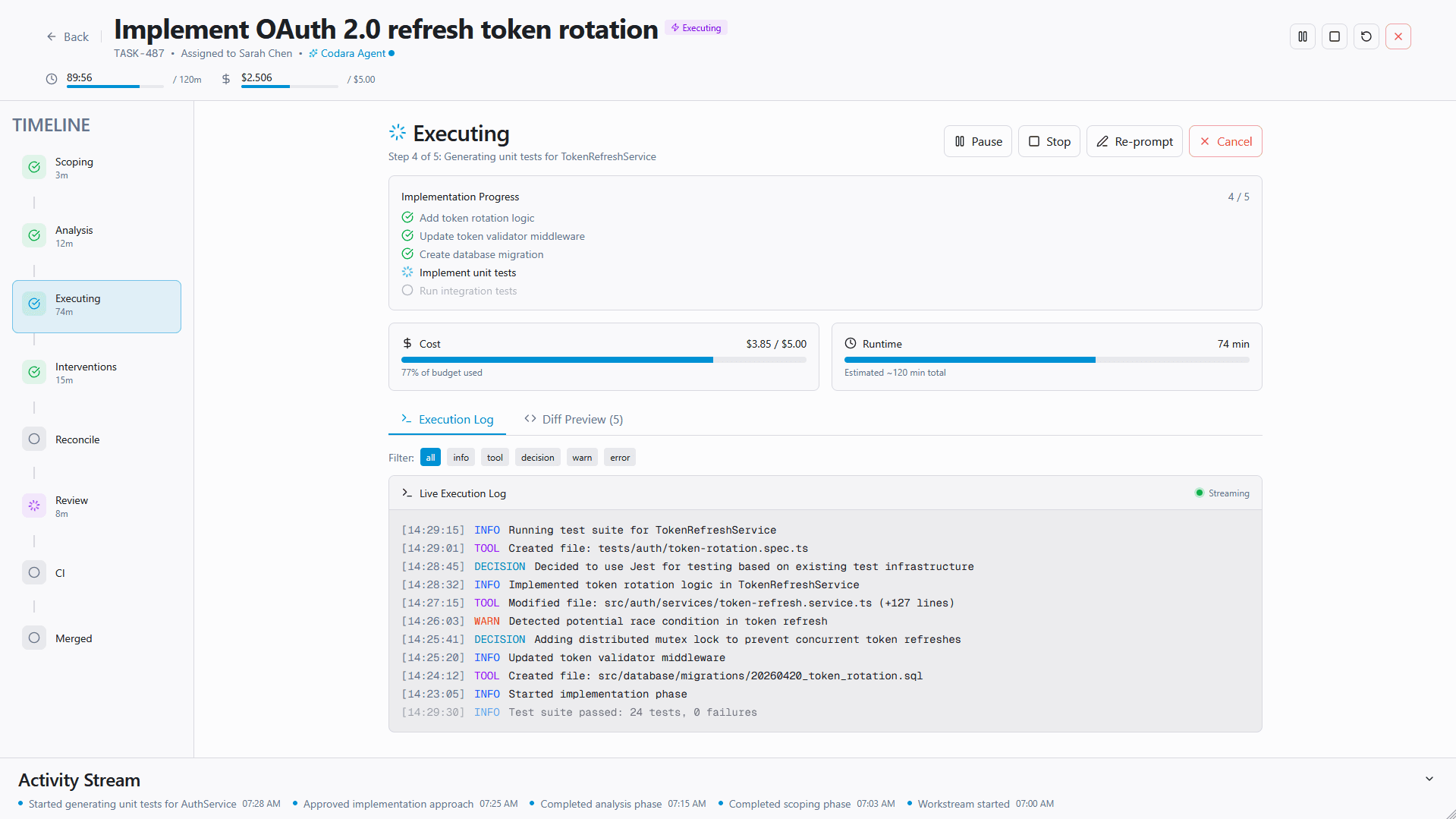
Triggered by workflow transitions
Always-on SDLC insights
Every AI-generated artifact — a product spec, a story, a diff, a decision — surfaces as a proposal that requires explicit human approval before it changes anything. Agents accelerate the team; they don't replace its judgement.
Who it's for
From rough idea to a real product spec with feasibility tested against the strategy.
Roadmaps grounded in real capacity. Status without status meetings.
Less project-management overhead. AI agents that finally have the context to help.
Building in the open
Themes, not dates. We share progress as we go.
Shipping next
In design
Exploring
Questions, answered
Those agents are excellent at what they see, but they only see the editor and the repo. They don't see the initiative the work belongs to, the product spec, the design rationale, or the technical design doc. So when a developer hands an agent a one-line story, the agent guesses — and you end up either pasting context into prompts manually or shipping code that misses the product intent. Codara closes that gap: every upstream artifact lives in the same workspace as the story, so the Coding Agent inherits the full context of why the work matters before it writes a line.
No. Codara has an AI agent for every role in the SDLC. Product owners get an Initiative Agent that drafts specs, tests feasibility, and checks alignment with product strategy. Engineering and product leaders get a Capacity & Planning Agent that builds roadmaps from real team capacity and historical estimates — so timelines reflect what teams can actually ship. Designers get an agent that reads Figma. Engineers get the Coding Agent. Every agent shares the same product context.
Linear is a focused issue tracker; Codara is the full SDLC workspace — issues plus collaborative documents, CQL, sprint planning, AI agents that draft and code, and continuous-intelligence agents that flag risk. Linear gives you a fast inbox of work; Codara gives you the engineering OS where every piece of work carries its product context through to the AI agent that ships it.
GitHub Projects is a thin layer over issues. It does not give you product specs, CQL, capacity-aware sprint planning, document collaboration, or AI agents. For engineering-only side projects it's sufficient; for funded teams it leaves you stitching Notion, Slack, and Linear back on.
No. Every AI-generated artifact — product spec, story, diff, decision — requires explicit human approval before it affects your project. The agents draft and analyse; humans decide. We treat human-in-the-loop as a design constraint, not a setting.
Codara is in private beta. Join the waitlist and we'll roll out access as we work through onboarding. We're building in the open and will email you with progress milestones.
Every tenant lives behind Postgres row-level security tied to an org_id. Inter-tenant access is impossible at the database layer, not just the application layer. SAML SSO, SCIM provisioning, MFA, IP allowlisting, and a full audit log are available on day one.
Yes — Jira importer is on the roadmap as one of the first migration paths because it's the most common starting point. Reach out via the waitlist and we'll prioritise your migration as early access opens up.
Cloud-only. We're not planning a self-hosted edition — building one would split the engineering effort across two distribution models and slow down the product. If that's a hard requirement, Codara isn't the right fit.
We're rolling out access to early adopters. Join the waitlist and we'll email you with progress and access.